Abstract
In deze omgeving laten we zien hoe je een aantal standaard componenten kunt aansturen of uitlezen met een Micro:bit
Updated: 10 Mar 2026
Jupyter Book has been rebuild from ground up using the MyST engine Jupyter et al., 2025. This allows to export content in multiple output formats including HTML, PDF and docx. In this paper we present an overview of the possibilities and demonstrate its working.
Background
Some background information about Jupyter Book and its features, like exporting to multiple formats as indicated in Figure 1.
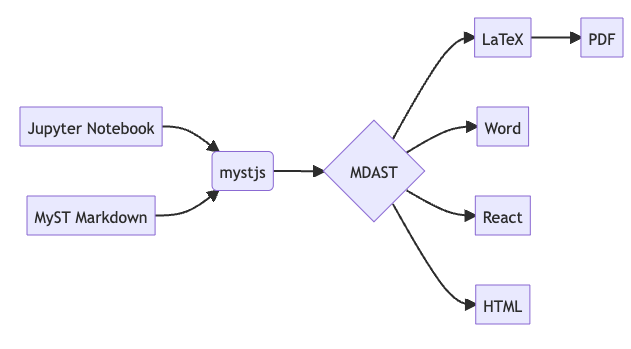
Figure 1:Some figure

Figure 2:A figure that is in the website but not in the PDF version.
- Jupyter, P., Bolyen, E., Caporaso, J. G., Cockett, R., Garside, D., Holdgraf, C., Hollands, A., Kent, J., Koch, F., Madge, J., McKay, M., Morrison, M., Pérez, F., Purves, S., Kelley, M. R., Rose, B. E. J., Sharan, M., Sipőcz, B. M., Walt, S. J., & Whitaker, K. J. (2025). Jupyter Book 2 and the MyST Document Stack: A modular, extensible, web-native stack for authoring and publishing computational narratives. Proceedings of the 24th Python in Science Conference, 173–193. 10.25080/hwcj9957